

注册环境#
上一教程介绍了如何创建自定义倒立摆环境。我们根据配置中 class_type 指定的类,手动创建了环境实例。
上一个教程中的环境创建
    # create environment configuration
    env_cfg = parse_env_cfg(
        "Isaac-Cartpole", device=args_cli.device, num_envs=args_cli.num_envs, overrides=hydra_overrides
    )
    # Launch the simulator runtime that the configuration needs
    with launch_simulation(env_cfg, args_cli):
        # setup RL environment
        env = instantiate(env_cfg)
虽然直接,但这种方法不够可扩展,因为我们有大量的环境套件。在本教程中,我们将展示如何使用 gymnasium.register() 方法将环境注册到 gymnasium 注册表中。这使我们可以通过 gymnasium.make() 函数创建环境。
本教程中的环境创建
    env_cfg, _ = resolve_task_config(args_cli.task, "")
    apply_env_overrides(args_cli, env_cfg)
    # pass the resolved task device through to the launcher
    args_cli.device = env_cfg.sim.device
    # configure recorders before validation so invalid clip settings fail before the launch
    log_dir = os.path.abspath(os.path.join("logs", f"{policy}_agent", normalize_task_name(args_cli.task)))
    apply_video_recording(env_cfg, log_dir, args_cli, subdir="play")
    # reject unsupported configurations before launching Kit or initializing a native physics backend
    try:
        validate(env_cfg)
    except (TypeError, ValueError) as exc:
        raise SystemExit(f"Invalid environment configuration: {exc}") from None

    with launch_simulation(env_cfg, args_cli), contextlib.ExitStack() as cleanup:
        env = gym.make(args_cli.task, cfg=env_cfg)
代码#
本教程对应 scripts/environments 目录中的 random_agent.py 脚本。它只是一个轻量入口,调用 isaaclab_rl.entrypoints 模块中的实际实现。
simple_agents.py 代码
  1# Copyright (c) 2022-2026, The Isaac Lab Project Developers (https://github.com/isaac-sim/IsaacLab/blob/main/CONTRIBUTORS.md).
  2# All rights reserved.
  3#
  4# SPDX-License-Identifier: BSD-3-Clause
  5
  6"""Checkpoint-free playback workflows for Isaac Lab environments.
  7
  8The zero and random agents are variations of playback that need no trained checkpoint:
  9the policy either infers finite zero or hold actions or samples uniform random actions.
 10"""
 11
 12from __future__ import annotations
 13
 14import argparse
 15import contextlib
 16import os
 17import sys
 18from collections.abc import Callable
 19from typing import Any, Literal
 20
 21import gymnasium as gym
 22import torch
 23
 24from isaaclab.app import add_launcher_args, launch_simulation
 25from isaaclab.envs.utils.spaces import sample_space
 26from isaaclab.utils import math as math_utils
 27from isaaclab.utils import validate
 28
 29import isaaclab_tasks  # noqa: F401
 30from isaaclab_tasks.utils import resolve_task_config, setup_preset_cli
 31
 32from .common import (
 33    add_video_args,
 34    apply_env_overrides,
 35    apply_video_recording,
 36    close_env,
 37    enable_cameras_for_video,
 38    normalize_task_name,
 39    video_playback_steps,
 40)
 41
 42# PLACEHOLDER: Extension template (do not remove this comment)
 43with contextlib.suppress(ImportError):
 44    import isaaclab_tasks_experimental  # noqa: F401
 45
 46PolicyName = Literal["zero", "random"]
 47"""Action policies supported by the checkpoint-free agents."""
 48
 49_DESCRIPTIONS: dict[str, str] = {
 50    "zero": "Zero agent for Isaac Lab environments.",
 51    "random": "Random agent for Isaac Lab environments.",
 52}
 53
 54_SEED = 42
 55
 56
 57def run(argv: list[str] | None = None, *, policy: PolicyName) -> None:
 58    """Run an Isaac Lab environment with a checkpoint-free policy.
 59
 60    Args:
 61        argv: Command-line arguments excluding the executable name. Reads ``sys.argv`` when omitted.
 62        policy: Action policy to apply, either inferred zero actions or uniform random actions.
 63
 64    Raises:
 65        ValueError: If the requested policy is not supported.
 66    """
 67    if policy not in _DESCRIPTIONS:
 68        raise ValueError(f"Unsupported policy {policy!r}. Expected one of: {sorted(_DESCRIPTIONS)}.")
 69
 70    args_cli = _parse_args(argv, policy)
 71    torch.manual_seed(_SEED)
 72
 73    env_cfg, _ = resolve_task_config(args_cli.task, "")
 74    apply_env_overrides(args_cli, env_cfg)
 75    # pass the resolved task device through to the launcher
 76    args_cli.device = env_cfg.sim.device
 77    # configure recorders before validation so invalid clip settings fail before the launch
 78    log_dir = os.path.abspath(os.path.join("logs", f"{policy}_agent", normalize_task_name(args_cli.task)))
 79    apply_video_recording(env_cfg, log_dir, args_cli, subdir="play")
 80    # reject unsupported configurations before launching Kit or initializing a native physics backend
 81    try:
 82        validate(env_cfg)
 83    except (TypeError, ValueError) as exc:
 84        raise SystemExit(f"Invalid environment configuration: {exc}") from None
 85
 86    with launch_simulation(env_cfg, args_cli), contextlib.ExitStack() as cleanup:
 87        env = gym.make(args_cli.task, cfg=env_cfg)
 88        cleanup.callback(lambda: close_env(env))
 89        print(f"[INFO]: Gym observation space: {env.observation_space}")
 90        print(f"[INFO]: Gym action space: {env.action_space}")
 91        env.reset()
 92        if policy == "zero":
 93            action_policy = create_zero_action_policy(env)
 94        else:
 95            action_policy = create_random_action_policy(env)
 96        print(f"[INFO] {policy.capitalize()} agent is running, press Ctrl+C to exit...")
 97
 98        budgets = [n for n in (args_cli.max_steps, video_playback_steps(args_cli, env_cfg)) if n is not None]
 99        max_steps = min(budgets, default=None)
100
101        # keep running while any visualizer is open and the step budget is not exhausted
102        sim = env.unwrapped.sim
103        step = 0
104        while sim.is_running():
105            if max_steps is not None and step >= max_steps:
106                break
107            step += 1
108            with torch.inference_mode():
109                env.step(action_policy())
110
111
112def create_zero_action_policy(env: gym.Env) -> Callable[[], Any]:
113    """Create a policy that emits finite actions for passive environment playback.
114
115    Manager-based environments infer hold commands for absolute task-space action terms and use literal zeros for all
116    other terms. Direct-workflow environments use zero-filled samples of their declared Gymnasium spaces, including
117    composite and multi-agent spaces.
118    """
119    unwrapped = env.unwrapped
120    action_manager = getattr(unwrapped, "action_manager", None)
121    if action_manager is not None:
122        return _create_manager_zero_action_policy(action_manager, unwrapped)
123
124    if hasattr(unwrapped, "action_spaces"):
125        actions = {
126            agent: sample_space(space, unwrapped.device, batch_size=unwrapped.num_envs, fill_value=0)
127            for agent, space in unwrapped.action_spaces.items()
128        }
129        return lambda: actions
130
131    actions = sample_space(unwrapped.single_action_space, unwrapped.device, batch_size=unwrapped.num_envs, fill_value=0)
132    return lambda: actions
133
134
135def create_random_action_policy(env: gym.Env) -> Callable[[], torch.Tensor]:
136    """Create a policy that samples uniform random actions in ``[-1, 1]``."""
137    device = env.unwrapped.device
138    return lambda: 2 * torch.rand(env.action_space.shape, device=device) - 1
139
140
141def _create_manager_zero_action_policy(action_manager: Any, env: Any) -> Callable[[], torch.Tensor]:
142    """Create a zero-action policy from the active action terms."""
143    actions = torch.zeros_like(action_manager.action)
144    term_policies = []
145    index = 0
146    for term_name in action_manager.active_terms:
147        term = action_manager.get_term(term_name)
148        term_policy = _create_action_term_zero_policy(term, env)
149        if term_policy is not None:
150            term_policies.append((slice(index, index + term.action_dim), term_policy))
151        index += term.action_dim
152
153    def policy() -> torch.Tensor:
154        actions.zero_()
155        for action_slice, term_policy in term_policies:
156            actions[:, action_slice] = term_policy()
157        if not torch.isfinite(actions).all():
158            raise RuntimeError("Zero agent inferred non-finite actions from the current environment state.")
159        return actions
160
161    return policy
162
163
164def _create_action_term_zero_policy(term: Any, env: Any) -> Callable[[], torch.Tensor] | None:
165    """Create the specialized zero-action policy required by an action term."""
166    term_types = {cls.__name__ for cls in type(term).__mro__}
167
168    if "PinkInverseKinematicsAction" in term_types:
169        controlled_frame_ids, controlled_frame_names = term._asset.find_bodies(
170            list(term.cfg.target_eef_link_names.values()), preserve_order=True
171        )
172        if len(controlled_frame_ids) != len(term.cfg.target_eef_link_names):
173            raise ValueError(
174                "Expected one controlled body for every Pink IK target. Resolved "
175                f"{controlled_frame_names} from {list(term.cfg.target_eef_link_names.values())}."
176            )
177        if len(controlled_frame_ids) != term._num_frame_tasks:
178            raise ValueError(
179                f"Pink IK has {term._num_frame_tasks} variable frame tasks but "
180                f"{len(controlled_frame_ids)} controlled bodies were configured."
181            )
182
183        def pink_policy() -> torch.Tensor:
184            frame_poses = term._asset.data.body_link_pose_w.torch[:, controlled_frame_ids].clone()
185            frame_poses[..., :3] -= env.scene.env_origins.unsqueeze(1)
186            hand_joint_positions = term._asset.data.joint_pos.torch[:, term._hand_joint_ids]
187            return torch.cat((frame_poses.flatten(start_dim=1), hand_joint_positions), dim=-1)
188
189        return pink_policy
190
191    if "DifferentialInverseKinematicsAction" in term_types and not term.cfg.controller.use_relative_mode:
192
193        def differential_ik_policy() -> torch.Tensor:
194            ee_pos, ee_quat = term._compute_frame_pose()
195            command = ee_pos if term.cfg.controller.command_type == "position" else torch.cat((ee_pos, ee_quat), dim=-1)
196            return _unscale_action(command - term._offset, term._scale)
197
198        return differential_ik_policy
199
200    if "RMPFlowAction" in term_types and not term.cfg.use_relative_mode:
201
202        def rmpflow_policy() -> torch.Tensor:
203            ee_pos, ee_quat = term._compute_frame_pose()
204            return _unscale_action(torch.cat((ee_pos, ee_quat), dim=-1), term._scale)
205
206        return rmpflow_policy
207
208    if "OperationalSpaceControllerAction" in term_types and term._pose_abs_idx is not None:
209        term_actions = torch.zeros_like(term.raw_actions)
210
211        def operational_space_policy() -> torch.Tensor:
212            term_actions.zero_()
213            term._compute_ee_pose()
214            term._compute_task_frame_pose()
215            if term._task_frame_pose_b is None:
216                ee_pos_task = term._ee_pose_b[:, :3]
217                ee_quat_task = term._ee_pose_b[:, 3:7]
218            else:
219                ee_pos_task, ee_quat_task = math_utils.subtract_frame_transforms(
220                    term._task_frame_pose_b[:, :3],
221                    term._task_frame_pose_b[:, 3:7],
222                    term._ee_pose_b[:, :3],
223                    term._ee_pose_b[:, 3:7],
224                )
225            term_actions[:, term._pose_abs_idx : term._pose_abs_idx + 3] = _unscale_action(
226                ee_pos_task, term._position_scale
227            )
228            term_actions[:, term._pose_abs_idx + 3 : term._pose_abs_idx + 7] = _unscale_action(
229                ee_quat_task, term._orientation_scale
230            )
231            return term_actions
232
233        return operational_space_policy
234
235    return None
236
237
238def _unscale_action(command: torch.Tensor, scale: torch.Tensor) -> torch.Tensor:
239    """Map a processed command back to policy-action coordinates without division by zero."""
240    return torch.where(scale != 0.0, command / scale, torch.zeros_like(command))
241
242
243def _parse_args(argv: list[str] | None, policy: PolicyName) -> argparse.Namespace:
244    """Parse the command line of a checkpoint-free agent and hand the remainder to Hydra."""
245    parser = argparse.ArgumentParser(description=_DESCRIPTIONS[policy])
246    parser.add_argument(
247        "--disable_fabric", action="store_true", default=False, help="Disable fabric and use USD I/O operations."
248    )
249    parser.add_argument("--num_envs", type=int, default=None, help="Number of environments to simulate.")
250    parser.add_argument("--task", type=str, default=None, help="Name of the task.")
251    parser.add_argument(
252        "--max_steps", type=int, default=None, help="Number of environment steps to run. Runs unbounded when omitted."
253    )
254    add_video_args(parser, action=f"the {policy} agent run")
255    add_launcher_args(parser)
256    # let task configs select the simulation device and keep checkpoint-free agents on the kitless default path
257    parser.set_defaults(device=None, visualizer=["newton_gl"])
258    args_cli, hydra_args = setup_preset_cli(parser, argv)
259    enable_cameras_for_video(args_cli)
260    sys.argv = [sys.argv[0]] + hydra_args
261    return args_cli
代码解释#
envs.ManagerBasedRLEnv 类继承自 gymnasium.Env 类以遵循标准接口。然而,与传统的 Gym 环境不同, envs.ManagerBasedRLEnv 实现了*向量化*环境。这意味着多个环境实例同时在同一进程中运行,并且所有数据都以批处理方式返回。
同样, envs.DirectRLEnv 类也从 gymnasium.Env 类继承以用于直接工作流程。对于 envs.DirectMARLEnv ,虽然它不是从 Gymnasium 继承的,但可以以相同的方式注册和创建。
使用 gym 注册表#
要注册一个环境,我们使用 gymnasium.register() 方法。此方法接收环境名称、环境类的入口点以及环境配置类的入口点。
备注
gymnasium 注册表是一个全局注册表。因此,确保环境名称是唯一的很重要。否则,在注册环境时注册表会抛出错误。
基于管理器的环境#
对于基于管理器的环境,以下展示了 isaaclab_tasks.core.cartpole 子包中倒立摆环境的注册调用:
from . import agents

        "rsl_rl_cfg_entry_point": f"{agents.__name__}.rsl_rl_ppo_cfg:CartpolePPORunnerCfg",
        "torchrl_cfg_entry_point": f"{agents.__name__}.torchrl_ppo_cfg:CartpolePPOCfg",
        "default_agent": "rsl_rl",
        "rsl_rl_with_symmetry_cfg_entry_point": (
            f"{agents.__name__}.rsl_rl_ppo_cfg:CartpolePPORunnerWithSymmetryCfg"
        ),
        "skrl_cfg_entry_point": f"{agents.__name__}:skrl_manager_ppo_cfg.yaml",
        "sb3_cfg_entry_point": f"{agents.__name__}:sb3_ppo_cfg.yaml",
    },
)

gym.register(
    id="Isaac-Cartpole-Camera",
    entry_point="isaaclab.envs:ManagerBasedRLEnv",
    disable_env_checker=True,
id 参数是环境名称。按照约定,我们为环境名称添加 Isaac- 前缀,以便在注册表中搜索。前缀后通常依次是任务名和机器人名。例如,使用 ANYmal C 在平地上进行足式运动的环境叫作 IsaacContrib-Velocity-Flat-AnymalC 。版本号 v<N> 通常用来区分同一环境的不同变体,否则环境名称可能过长、难以阅读。
entry_point 参数是环境类的入口点。入口点是一个 <module>:<class> 形式的字符串。对于 cartpole 环境,入口点是 isaaclab.envs:ManagerBasedRLEnv 。入口点用于在创建环境实例时导入环境类。
env_cfg_entry_point 参数指定了环境的默认配置。默认配置使用 isaaclab_tasks.utils.parse_env_cfg() 函数加载。然后将其传递给 gymnasium.make() 函数以创建环境实例。配置入口点可以是 YAML 文件或 Python 配置类。
直接式的环境#
对于基于直接的环境,环境注册遵循类似的模式。与将环境的入口点注册为 ManagerBasedRLEnv 类不同,我们将环境的入口点注册为环境的实现类。此外,我们将环境名称添加后缀 -Direct 以区分其与基于管理器的环境。
例如,以下展示了 isaaclab_tasks.core.cartpole 子包中倒立摆环境的注册调用:
from . import agents

        "sb3_cfg_entry_point": f"{agents.__name__}:sb3_ppo_cfg.yaml",
    },
)

gym.register(
    id="Isaac-Cartpole-Camera-Direct",
    entry_point=f"{__name__}.cartpole_direct_camera_env:CartpoleCameraEnv",
    disable_env_checker=True,
    kwargs={
        "env_cfg_entry_point": f"{__name__}.cartpole_direct_camera_env_cfg:CartpoleCameraEnvCfg",
        "rl_games_cfg_entry_point": f"{agents.__name__}:rl_games_camera_ppo_cfg.yaml",
        "rsl_rl_cfg_entry_point": f"{agents.__name__}.rsl_rl_ppo_cfg:CartpoleCameraDirectPPORunnerCfg",
创建环境#
要将所有 isaaclab_tasks 扩展提供的环境通知 gym 注册表,我们必须在脚本开头导入模块。这将执行 __init__.py 文件,该文件遍历所有子包并注册它们各自的环境。
import isaaclab_tasks # noqa: F401
在本教程中,任务名称从命令行中读取。任务名称用于解析默认配置以及创建环境实例。此外,其他解析的命令行参数,如环境数量、仿真设备以及是否进行渲染,用于覆盖默认配置。
    env_cfg, _ = resolve_task_config(args_cli.task, "")
    apply_env_overrides(args_cli, env_cfg)
    # pass the resolved task device through to the launcher
    args_cli.device = env_cfg.sim.device
    # configure recorders before validation so invalid clip settings fail before the launch
    log_dir = os.path.abspath(os.path.join("logs", f"{policy}_agent", normalize_task_name(args_cli.task)))
    apply_video_recording(env_cfg, log_dir, args_cli, subdir="play")
    # reject unsupported configurations before launching Kit or initializing a native physics backend
    try:
        validate(env_cfg)
    except (TypeError, ValueError) as exc:
        raise SystemExit(f"Invalid environment configuration: {exc}") from None

    with launch_simulation(env_cfg, args_cli), contextlib.ExitStack() as cleanup:
        env = gym.make(args_cli.task, cfg=env_cfg)
一旦创建环境,其余执行将遇到标准的重置和步进。
代码执行#
现在我们已经浏览了代码,让我们运行脚本并查看结果:
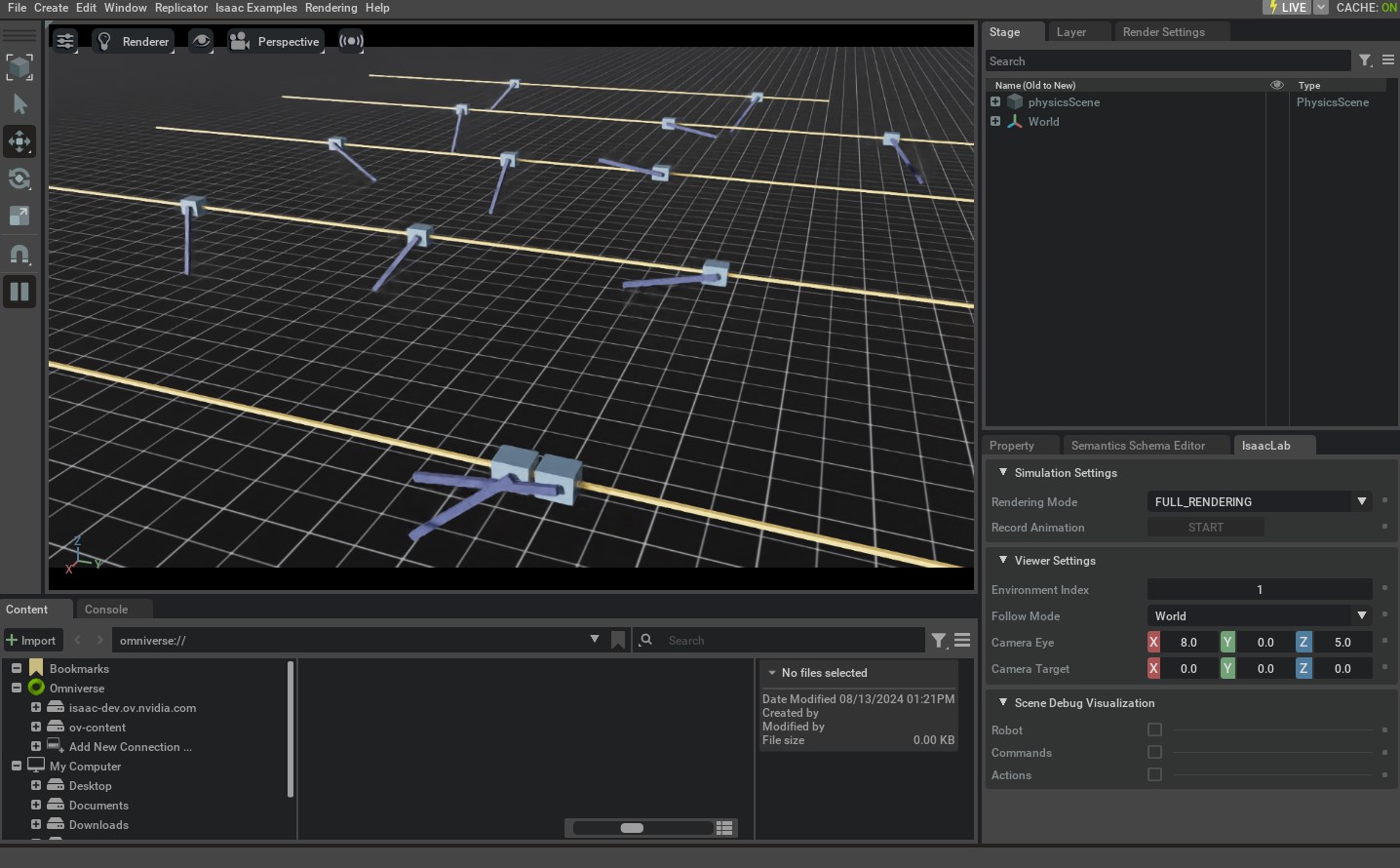
uv run python scripts/environments/random_agent.py --task Isaac-Cartpole --num_envs 32 --viz kit
./isaaclab.sh -p scripts/environments/random_agent.py --task Isaac-Cartpole --num_envs 32 --viz kit
这将打开一个与 创建基于管理器的强化学习环境 教程类似的场景。要停止仿真,您可以关闭窗口,或在终端中按 Ctrl+C 。
此外,您还可以通过显式设置 --device 的值将仿真设备从 GPU 更改为 CPU:
uv run python scripts/environments/random_agent.py --task Isaac-Cartpole --num_envs 32 --device cpu --viz kit
./isaaclab.sh -p scripts/environments/random_agent.py --task Isaac-Cartpole --num_envs 32 --device cpu --viz kit
使用 --device cpu 标志,仿真将在 CPU 上运行。这对于调试仿真很有用。但是,与在 GPU 上运行相比,仿真速度会慢得多。